
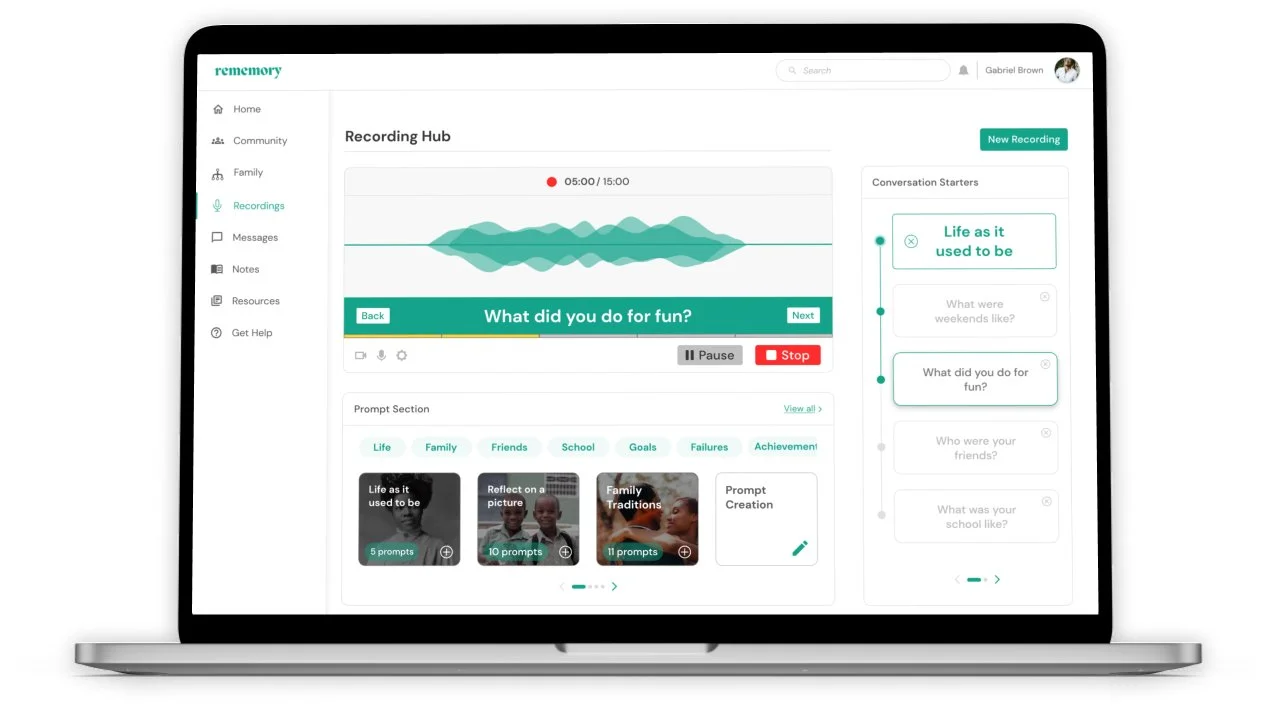
Rememory
Client: Kinkofa
Duration: 3 Weeks
Tools: Notion, Figma, Google Docs & Drive
Role: UI Architect, UX Researcher
Team: Laura Prezera, Nora Lotfy
For this project, my team and I were presented with helping a client create a desktop application that gives users the ability to record and save stories for publishing or personal use.
Overview
Constraints: We were asked to use their own design system and follow their guidelines in creating the website. The design of Rememory is meant to be similar to the parent company (Kinkofa).
Problem & Solution
Solution: Rememory requires a platform that encourages its users to record their oral history, save and share it to the Rememory community. The platform should be easy to navigate and be identifiable as a “daughter” of Kinkofa.
Problem: Users need a platform where they can easily record, store, share and discover family history. As a connected community, their history can be preserved.
Discover

User & Market Research
Starting off, we were presented users and questions from the client to get an understanding of the users needs. With these findings we produced qualitative research.
Users record stories in different places, and on different devices
Findings
Users do not (always) need prompts
Users want to be able to edit and share their recordings
Users want storage for their recordings
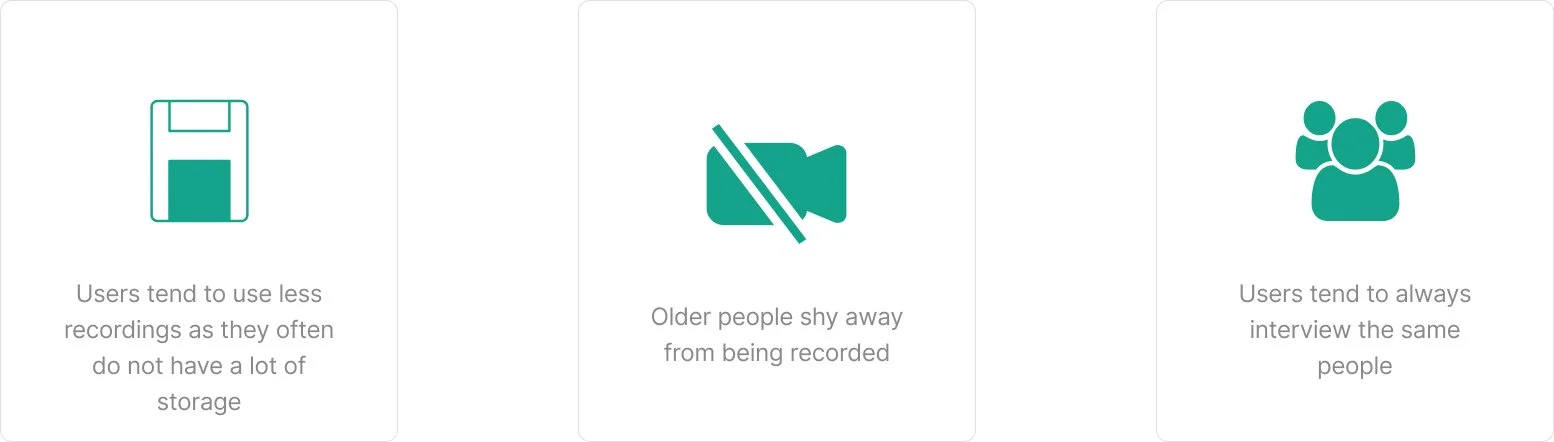
After the interviews, my team and I conducted an affinity map and discovered some pain points from users and their needs. A few of the major pain points are presented.
Affinity Takeaways
How Might We?
After establishing the takeaways from the interviews, we were left with some questions to help us form some potential trends and needs of the users. These trends in-hand helped form “How Might We” statements to encourage further development of Rememory.
HMW: Help users get started on their oral history journey?
HMW: Help users store their oral history stories for years to come?
HMW: Create a community driven platform where users can discover other stories?
HMW: Help users ask the right questions to capture as much family history as possible?
HMW: Make the platform more accessible so elders can record on their own?
Market Research
Understanding the potential competitors on how they solved problems and implemented features on those applications has helped me as a designer to define what creative solutions can be achieved for the success of the platform. The four main competitors are Storycorps, Remento, Lalo, and Cappuccino.
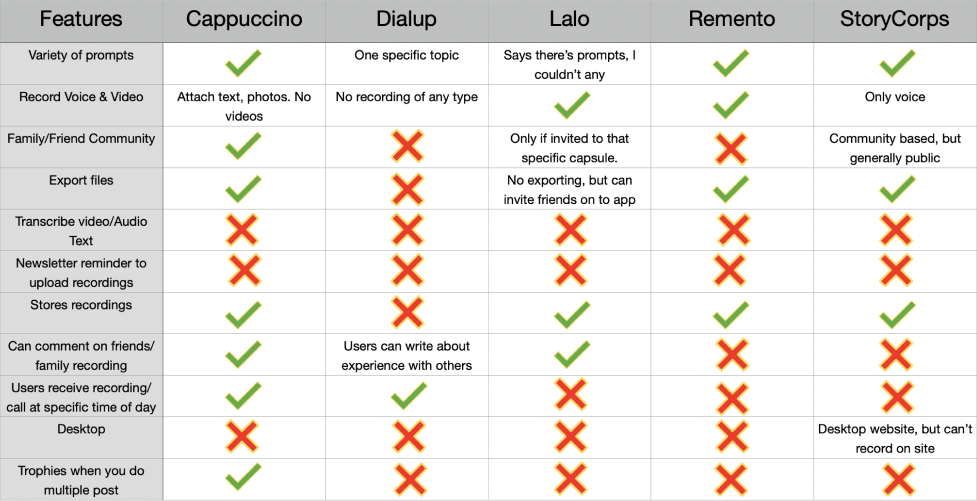
Feature Inventory
Define
Synthesizing Findings
In this next phase we pursued further upon our findings. With these findings we were able to present opportunities, weaknesses and build upon finds after conducting a SWOT analysis.
Strengths
SWOT Analysis
Linkage between information that is stored from Kinkofa and allows users to view distant relatives information.
Digitalizing a memory box for users to reference their older relatives.
Weaknesses
Figuring out the linkage between information from the genealogy results and how they can be shared in Rememory for easy accessibility.
Threats
Expanding the businesses under Kinkofa.
getting more people throughout the communities engaged with their heritage.
The lack of a mobile web version may grant some constraints for users that prefer mobile over desktop.
Opportunities
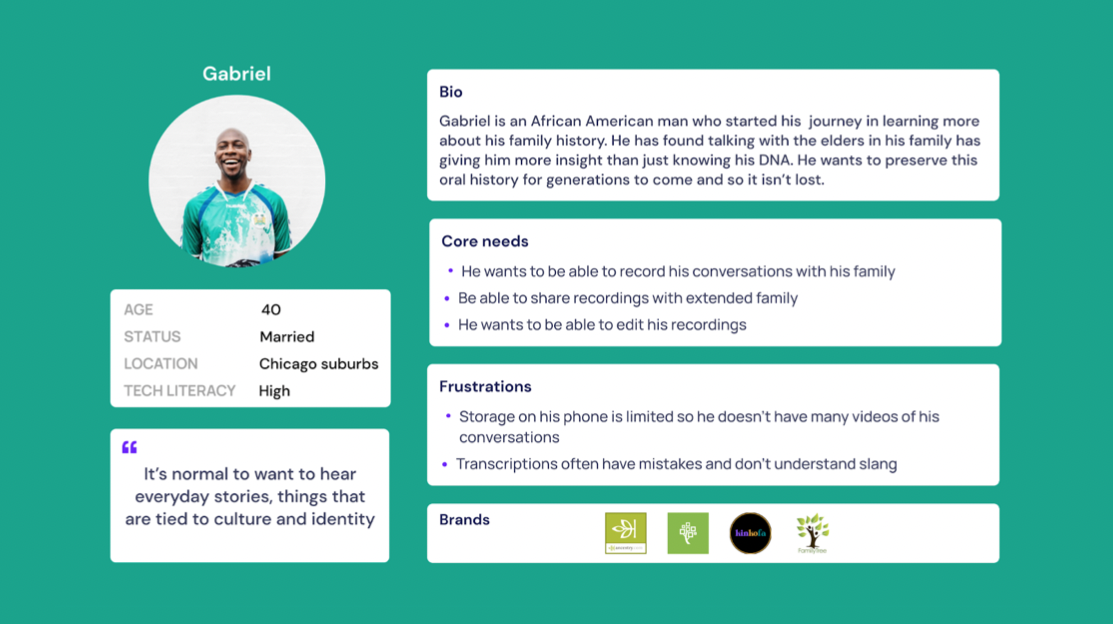
In order to get an understanding of who a potential user could be, a user persona was needed to identify core needs and frustrations. These specifics helped guide in the design and ideation phase. The use of the persona allowed my team to move along to the developing phase.
Persona
Develop
Ideating Ideas
Due to time constraints set by the client we had to move past sketching and focus on wireframes and the user flow of the MVP.
During this phase we defined the main user flow for the main viable product. This method of creating the user flow helped establish the ideal direction in how to move further and create the Rememory platform. The purpose of this was to structure how the user may begin and finish using the product from start to finish.
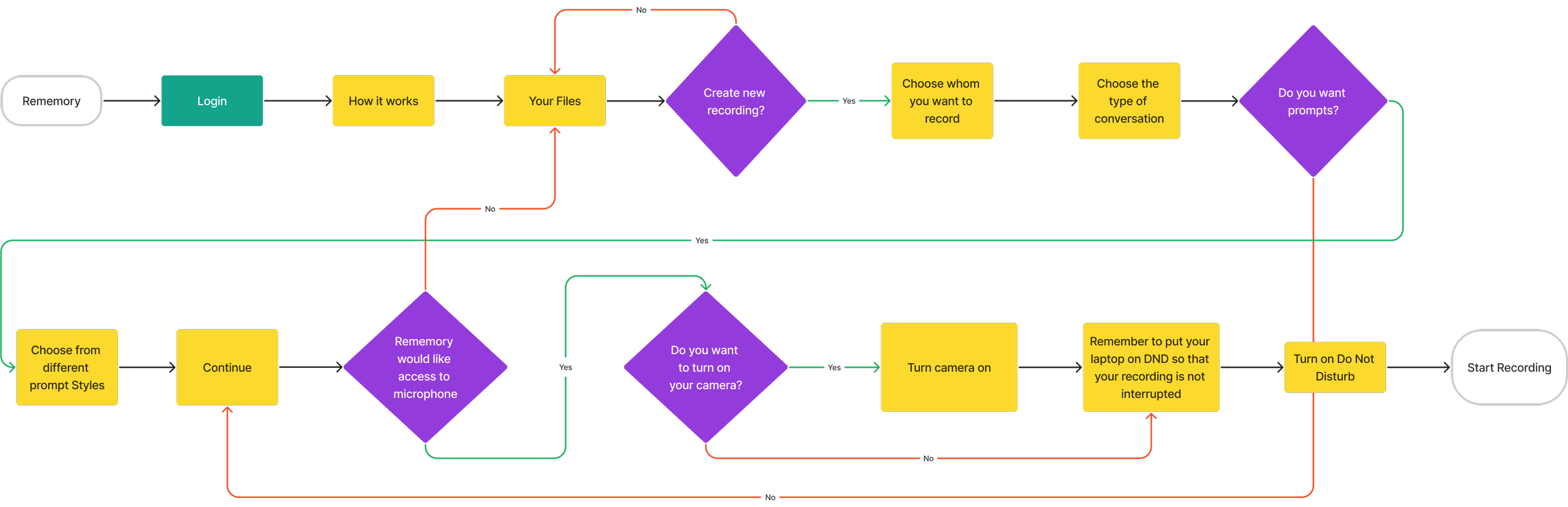
User Flow
To pursue further development into the ideating phase, we were tasked with creating many of the new structuring from scratch with the design system that was provided.
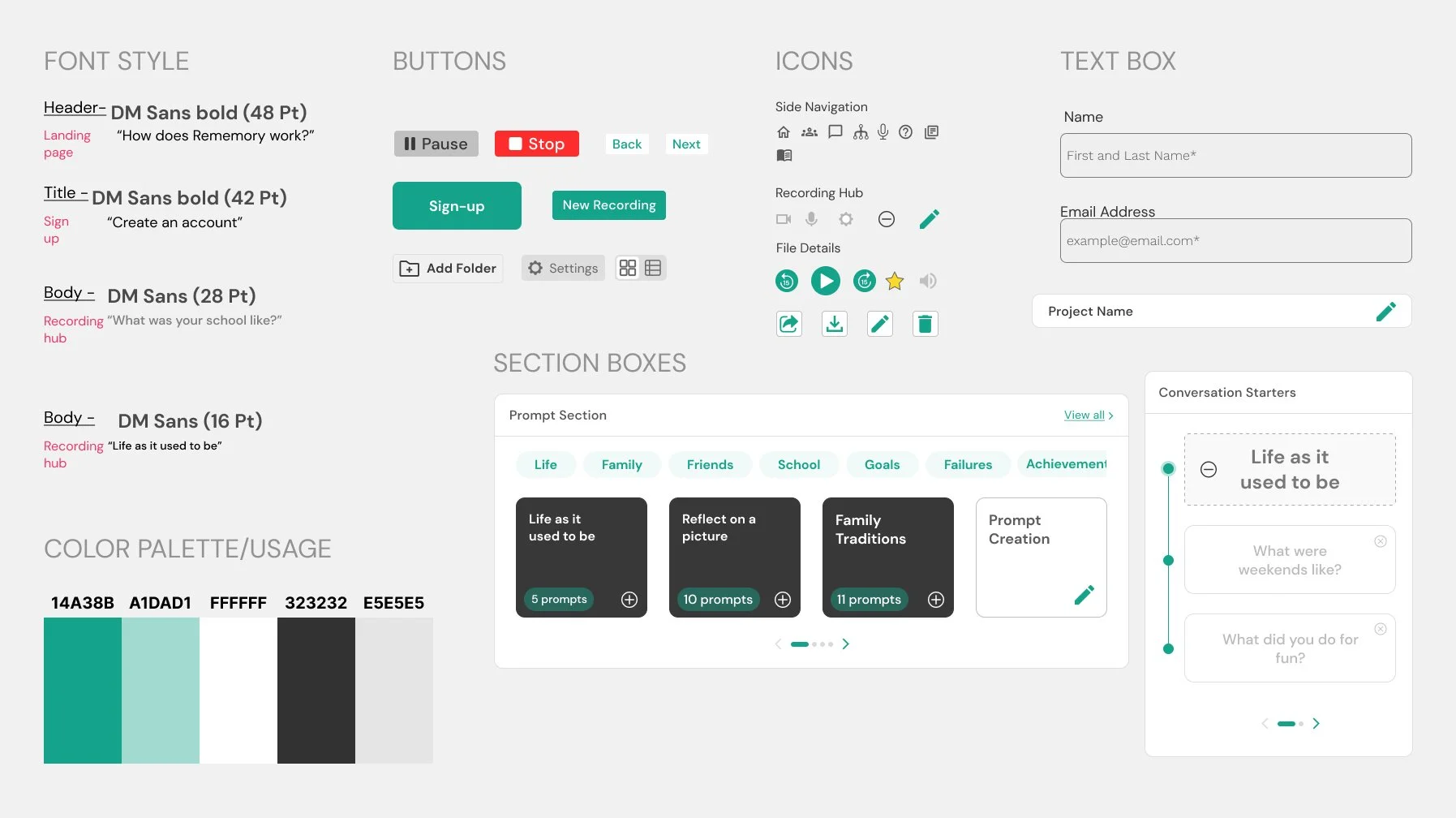
Design System
Deliverables
Implementation & Building
During this last phase, the prototype was already partially mid fidelity from showcasing it for the clients. With this prototype we were then ready to move on to user testing.
High Fidelity Wireframes
A/B Testing Analysis
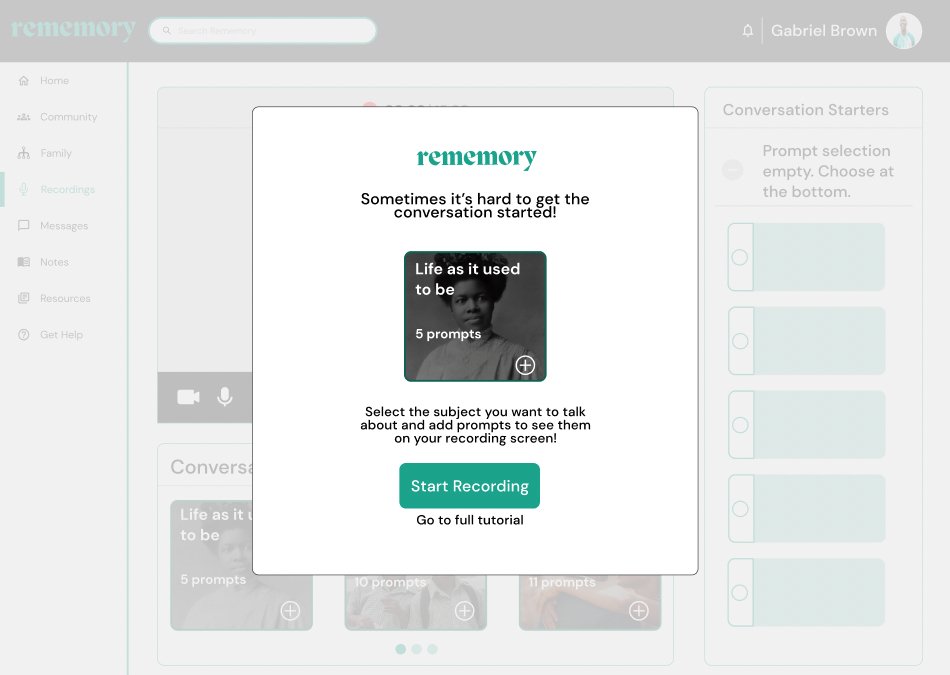
Initial Thoughts: Users are confused when they first enter into the rememory platform. There isn’t enough supporting detail as to a first step for the user. As a team, we concluded we were going based on the assumption that the user would know the first step.
Results: A clear indication before recording to remind users about how to use the prompt section if needed. Seen here.
During this process of usability testing, we ran two different tests, each time with different users. This strategy was to determine if our initial thoughts were correct and if it impacted errors, time taken to achieve a task. To simplify findings I averaged out key metrics and also displayed how they were tracked on a scatter chart based on five users testing Rememory.
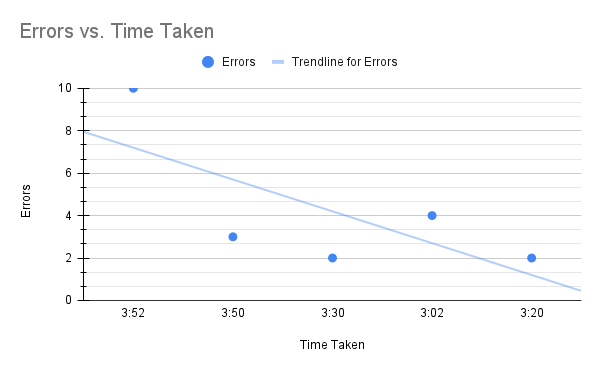
Average Time Entered: 3:30
Average Errors by users: 4.2
Average of total clicks: 15.2
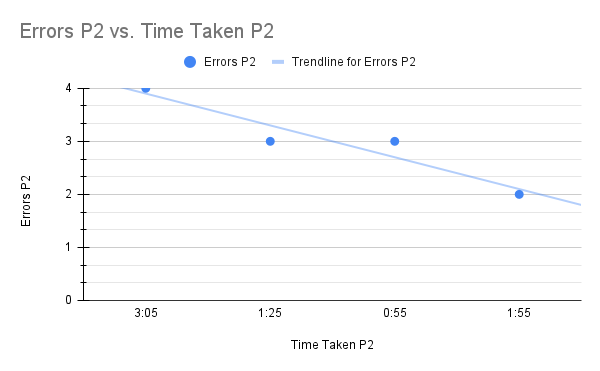
Average Time Entered: 1:29
Average Errors by users: 2.6
Average of total clicks: 14
What’s Next and Reflection
This project has helped me understand the importance of teamwork building, good communication skills, and learning how to ideate at a more rapid speed. Many of these values I learned, I believe are crucial going forward in my journey of UX design, and I’m happy to have learned it at this point rather than later. Overall, I am pleased with the work my team and I created, and I’m honored to have been part of the process collaborating not only with my teammates, but also the Kinkofa company.
Make further enhancements in terms of the features and what users can do on Rememory with their recordings
Produce a responsive way for users to use mobile and tablet as other options when recording
Continue more A/B testing for when users are done recording and see if the flow aligns with users expectations
Given The Opportunity, I would